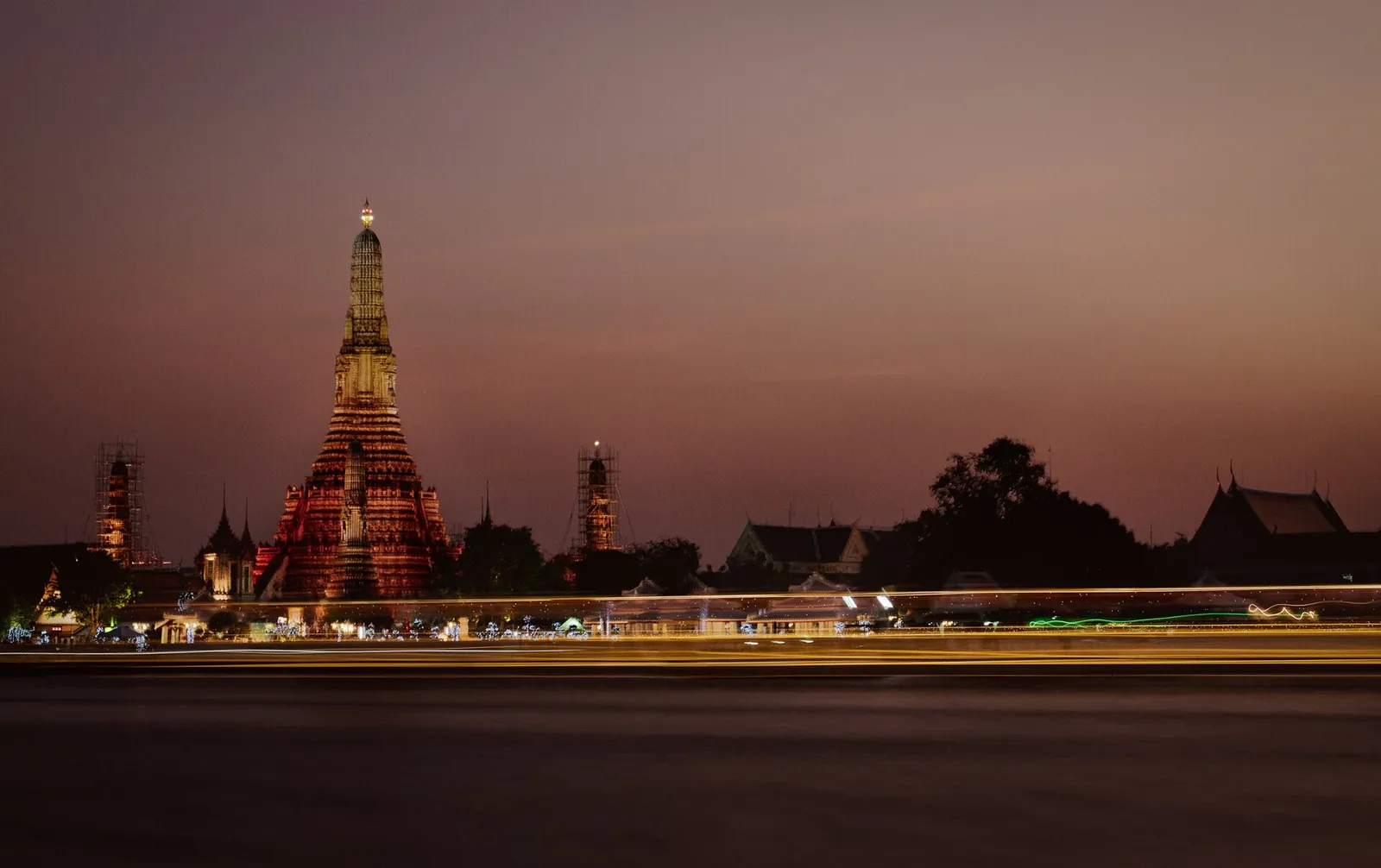
Bangkok rewards patience. Most people give it two rushed days between islands and never see past the traffic, but the city unfolds slowly, temple by temple, canal by canal, food stall by food stall. Five days lets you take the river at its own pace, eat properly, and find the quiet corners that make the noise worth it. Here is how to spend them. For orientation before you arrive, our Bangkok guide and first time in Thailand notes are a good start, and getting around Thailand explains the boats and trains you will lean on all week.
Itinerary at a glance
| Day | Area | Signature experience |
|---|---|---|
| 1 | Rattanakosin (old royal city) | Grand Palace, Wat Pho and Wat Arun at dusk |
| 2 | Chao Phraya and Thonburi | Express boat, longtail through the canals, the flower market |
| 3 | Chinatown and old town | Eating your way down Yaowarat after dark |
| 4 | Modern Bangkok | Jim Thompson House, a mall food court, a rooftop |
| 5 | Day trip | Ayutthaya’s ruins, or Amphawa’s evening market |
Day 1: The royal city
Start early at The Grand Palace and Wat Phra Kaew, the Temple of the Emerald Buddha, inside the same walls. Go first thing to beat both the heat and the crowds. The dress code here is strictly enforced: shoulders and knees covered for everyone, and people are turned away every single day. Wear light long trousers and bring a scarf. Entry runs in the region of 500 baht; confirm at the gate.
Walk next door to Wat Pho and the vast gold reclining Buddha, one of the calmest big-ticket sights in the city. Break for a riverside lunch, then cross the Chao Phraya on the little ferry to Wat Arun, the Temple of Dawn, saving it for late afternoon when the light softens on the porcelain-studded spire. End with mango sticky rice from a street cart; it is naturally dairy-free and a reliable pick for vegans.
Wow moment: climbing partway up Wat Arun’s steep central prang as the sun drops behind Thonburi. The steps are steep and can be slippery, so take them slowly and hold the rail.
Day 2: River and canals
Today belongs to the water. Ride the Chao Phraya express boat, the cheapest and best introduction to the city, from pier to pier for a handful of baht per hop. Then hire a longtail to slip into the Thonburi canals, where wooden houses, orchid pots and canalside temples sit exactly as they have for generations. Agree the price before you board, and wear the life jacket if one is offered.
Eat boat noodles, small intense bowls of dark broth, at one of the canalside stalls; note the classic version contains pork and pork blood, so ask for a plain beef or vegetable bowl if that matters to you. Finish at Pak Khlong Talat, the flower market, best in the cool of the morning or late evening when the jasmine and marigold garlands arrive by the truckload. Read up on the wider scene in our Bangkok street food guide.
Wow moment: the sheer scale of the marigold mountains at Pak Khlong Talat, sold by the sackful to temples across the city.
Day 3: Chinatown and the old town
Spend the afternoon in Talat Noi, the old Chinese quarter of engine-workshops, tangled lanes and a riverside shrine, all in the same block. Most visitors stride straight past it toward Chinatown; slow down and wander the alleys of rusting car parts, street art and hidden cafes instead. Kaizen Coffee makes a good pause.
Climb the Golden Mount at Wat Saket in the late afternoon for a full sweep of the old city, around 100 baht to enter. Khao San Road sits a short walk west of it, and it is worth seeing once even if you have no intention of drinking there, because the street by day is a different place from the one it is famous for. Then time your arrival on Yaowarat Road for after dark, when the street kitchens fire up and the pavements turn into the single best food street in the country. Nai Ek Roll Noodle is a Chinatown institution (its signature bowls are pork-based), and for a temple stop nearby, Wat Traimit holds a five-tonne solid gold Buddha.
Wow moment: Talat Noi itself, the mechanics’ shops and the shrine sharing one block, a working neighbourhood that has quietly become one of Bangkok’s most photogenic corners.
Day 4: Modern Bangkok
Switch centuries. Start at the Jim Thompson House, the teak home of the American who revived Thai silk, a green oasis of art and gardens, entry roughly 200 baht with regular guided tours included. For lunch, do not overlook a mall food court: they are clean, cheap and genuinely excellent, with clearly labelled vegetarian stalls. If it is a weekend, swap the mall for the sprawling Chatuchak market instead.
Spend the afternoon in Lumphini Park or the newer Benjakitti Forest Park, then go up for a drink at Octave Rooftop Lounge or the classic Vertigo and Moon Bar. Rooftop bars enforce smart-casual dress, so leave the flip-flops at the hotel. More options in our Bangkok nightlife piece.
Wow moment: the Mahanakhon SkyWalk glass floor at sunset, the whole city grid lit up beneath your feet.
Day 5: Day trip
Two strong choices. Take the train or a river cruise north to Ayutthaya, the ruined former capital, where Wat Mahathat’s Buddha head cradled in tree roots and the elegant Wat Chaiwatthanaram reward a full unhurried day. Lunch at Malakor Kitchen and Cafe near the ruins. Our Ayutthaya day trip guide has the detail.
Alternatively, head to Amphawa in the afternoon for its evening floating market, a local weekend affair far removed from the staged daytime versions, best for grilled river prawns eaten from the boats (shellfish, so skip if that is a concern). See floating markets for the difference between them.
Wow moment: at Amphawa, the fireflies flickering in the riverside trees after dark on a short boat ride, seasonal and weather-dependent, so ask locally first.
Practical tips
- Getting in from the airport: see Bangkok airport transfers and, for city hops, BTS and Grab.
- Best season: Bangkok is hot year-round with a wetter spell roughly June to October; check best time to visit Thailand.
- Adding a beach without flying: Koh Chang is the closest proper island to Bangkok, reachable overland and by ferry in a day, and it is mountainous and forested rather than flat and built up.
- Food: many signature Bangkok dishes contain pork, shellfish or fish sauce. Vegetarian and vegan food is easy to find, especially in mall food courts and around Chinatown’s Talat Noi cafes. Our Thai food guide explains what to ask for, and eating vegetarian in Thailand covers why fish sauce and shrimp paste turn up in dishes that look meat-free, and the phrases that actually get them left out.
- Money and safety: budget notes are in Thailand budget and costs, and it is worth reading travel insurance before boat and canal trips. Prices above are approximate; always confirm at the gate or pier.