Chiang Mai is a different country from the south. It is cooler, slower and greener, ringed by mountains instead of coastline, and it rewards walking rather than rushing. Five days here lets you cover the old city on foot, climb to the mountain temple above town, spend a proper morning with rescued elephants, get your hands dirty in a cooking class, and still have a full day left for Chiang Rai’s strange and brilliant modern temples. Our Chiang Mai guide is worth reading before you land, and it is worth checking the best time to visit if you have flexibility, since the region’s burning season, roughly the early months of the year, can settle smoke haze over the valley for stretches at a time.
Itinerary at a glance
| Day | Base | The signature experience |
|---|---|---|
| 1 | Chiang Mai old city | A monk chat inside a centuries-old temple |
| 2 | Doi Suthep and the mountain | Climbing the naga staircase to the golden chedi |
| 3 | Chiang Mai countryside | A morning with rescued elephants at a genuine sanctuary |
| 4 | Nimman and the craft villages | Pounding your own curry paste at a market cooking class |
| 5 | Chiang Rai (day trip) | The mirrored, otherworldly White Temple |
Day 1: Chiang Mai’s old city
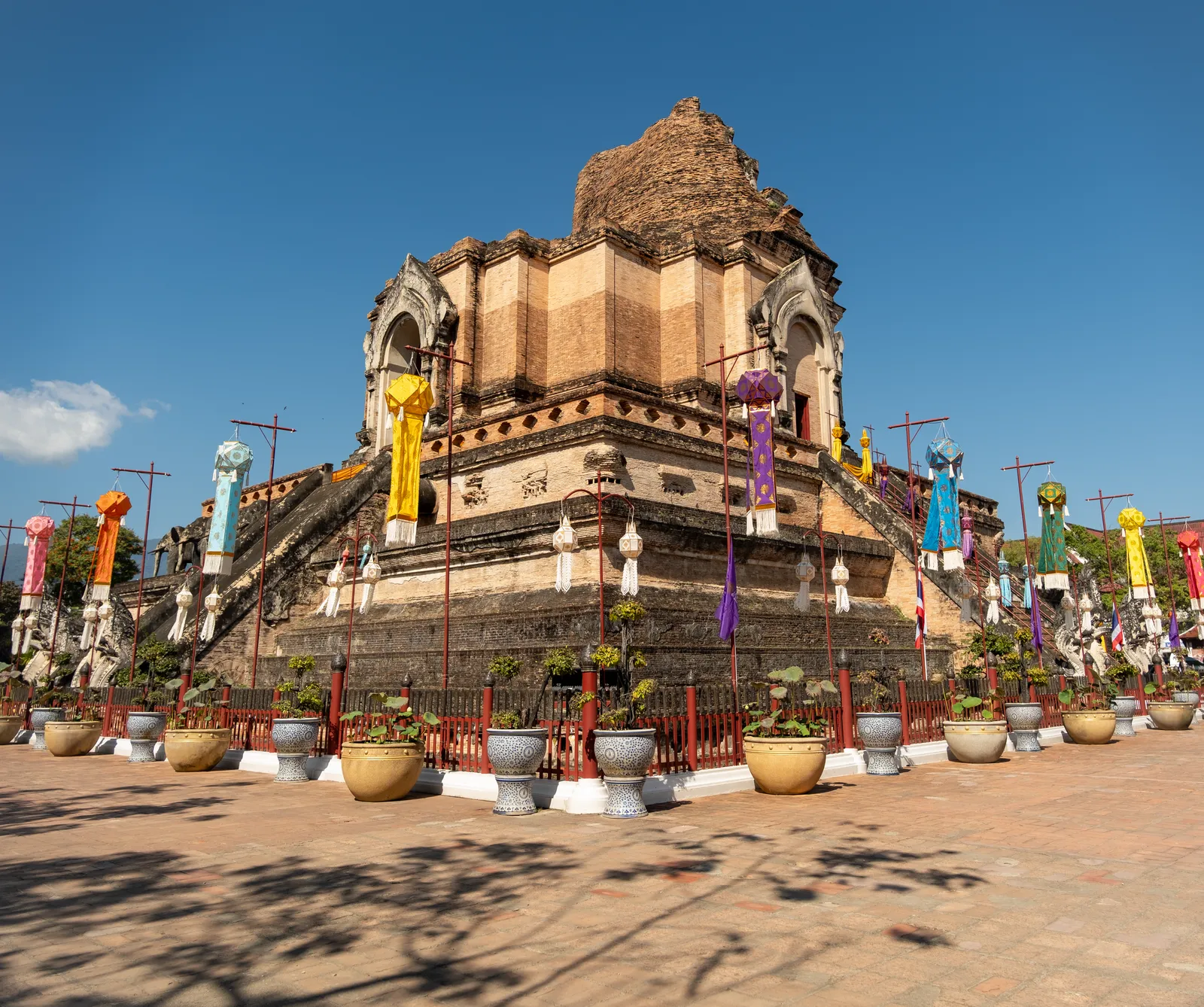
Base yourself somewhere inside or close to the old city walls (our where to stay in Chiang Mai guide has the detail). The old city is small enough to walk in full, a neat square still traced by its moat and fragments of the original brick wall. Spend the morning drifting between temples rather than ticking them off in order. Wat Chedi Luang is the anchor, its huge central stupa left broken and unrestored after an earthquake centuries ago, which somehow makes it more moving than a polished monument would be. Wat Phra Singh and Wat Chiang Man, the city’s oldest temple, are both close enough to add without much effort.
The reason to slow down here, though, is the monk chat. Several of the old city temples run informal sessions where novice monks sit down with visitors, usually in the temple grounds in the cooler part of the day, to practise their English and answer whatever you ask, from Buddhist philosophy to what monastery life actually involves. It costs nothing, nobody is performing for a camera, and it tends to be the moment people remember longest from the whole trip.
Food: khao soi, the north’s signature dish, a coconut curry noodle soup finished with crispy noodles on top. It barely exists south of here and is worth having more than once.
The signature experience: a monk chat in an old city temple courtyard, entirely free, entirely unstaged, and often the most genuine conversation of the whole trip.
Optional tour: if your dates land on a Sunday evening, the Sunday walking street closes the main old city road to traffic for food stalls and handicrafts stretching for blocks.
Day 2: Doi Suthep and the mountain
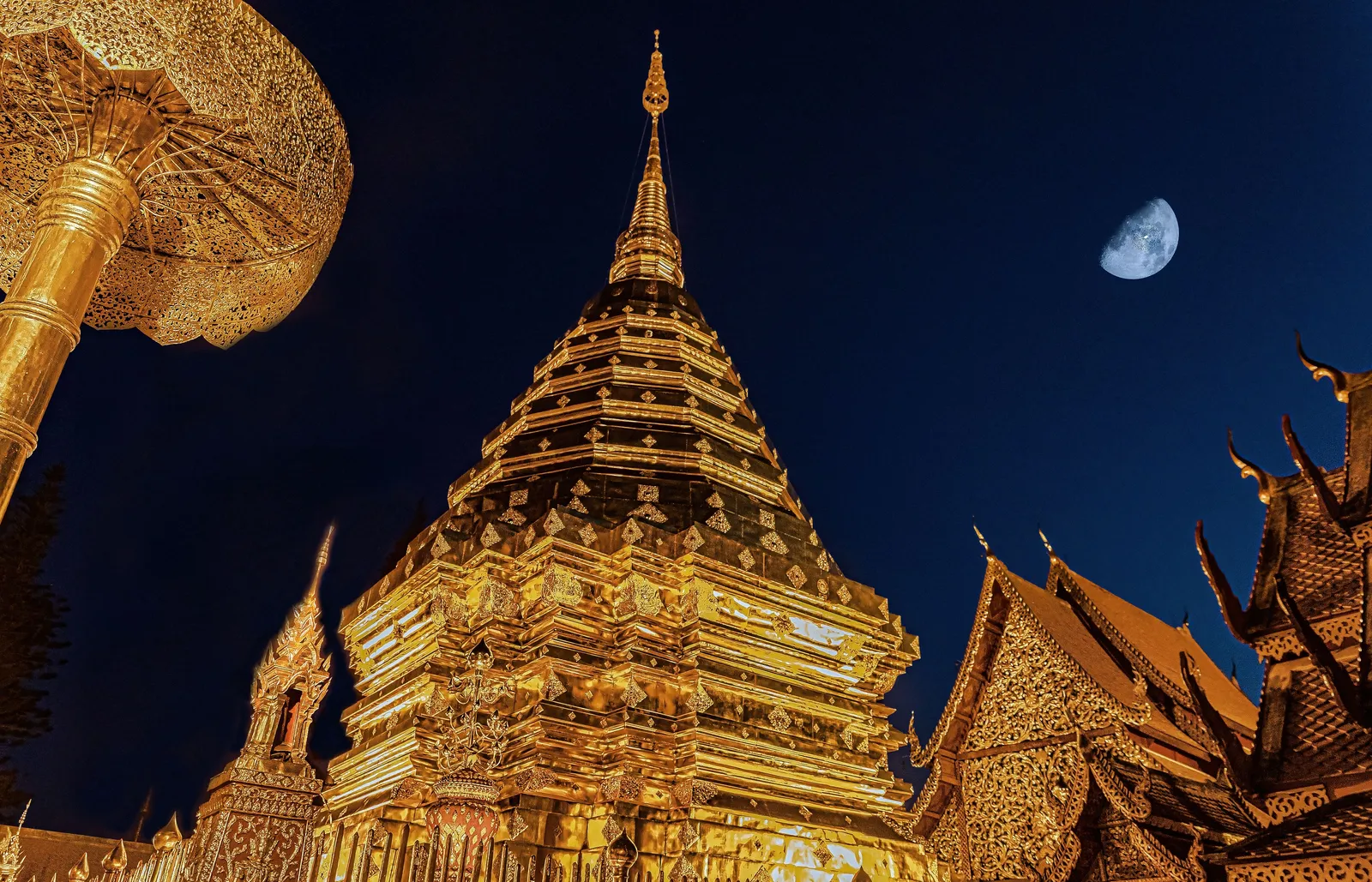
Doi Suthep rises directly behind the city, and the temple near its summit is the reason most visitors make the trip. A steep naga staircase, flanked the whole way up by a serpent’s scaled body in tile, leads to the golden chedi at the top. Take it slowly in the heat, and pause at the terrace for the view back over the valley, the whole city laid out below with the mountains rolling on beyond it.
Higher up the same road, the royal gardens are worth the extra stop when they are open to the public, a cooler, quieter counterpoint to the temple crowds below. On the way back down, look for a roadside stall selling northern sausage, sai ua, dense with lemongrass and herbs and unlike sausage anywhere else in the country.
Food: a mountain roadside stop for sai ua, northern sausage, eaten hot off the grill.
The signature experience: the climb up the naga staircase and the view over Chiang Mai from the temple terrace.
Optional tour: a short detour to a Hmong hill village further along the mountain road, for a look at a way of life quite different from the valley below.
Day 3: A morning with the elephants
Give today entirely to a genuine elephant sanctuary, and choose it carefully. A real sanctuary lets the herd set the pace: elephants graze, wander and bathe on their own terms, there is no riding and no queue of visitors lined up for a bathing photo, and the group size stays small enough that you are not one of forty people crowding a single animal. Ask direct questions before booking: whether elephants are ever ridden, whether hooks are used, and how much space the herd actually has, and if a deal looks too good, weigh it against our common Thailand scams guide before you pay a deposit. Our ethical elephant sanctuary guide goes through exactly what separates the real thing from a rebranded riding camp, and it is worth ten minutes before you hand over a deposit.
Most sanctuaries include a simple lunch as part of the day, often cooked by the same families who care for the elephants, and some offer a shorter half-day option if a full day feels like too much sun. Either way, come with closed shoes you do not mind getting muddy and sunscreen that has already been applied before you arrive, since some sanctuaries ask you not to apply it on site near the elephants.
Food: a home-style lunch is usually included, often served family-style at long tables.
The signature experience: standing at a respectful distance as the herd moves, feeds and bathes in a river on its own schedule.
Optional tour: several places offer a half-day version of the same visit for a lighter schedule, useful if you are combining it with something else that day.
Day 4: Craft and food day
Spend the morning in Nimman, the neighbourhood of independent cafes, design shops and small galleries that has become the city’s creative quarter, a good contrast after three days of temples. Then head to a cooking class that starts, as the best ones do, at a local market rather than in the kitchen, walking you through the vegetables, herbs and pastes before you ever pick up a pestle.
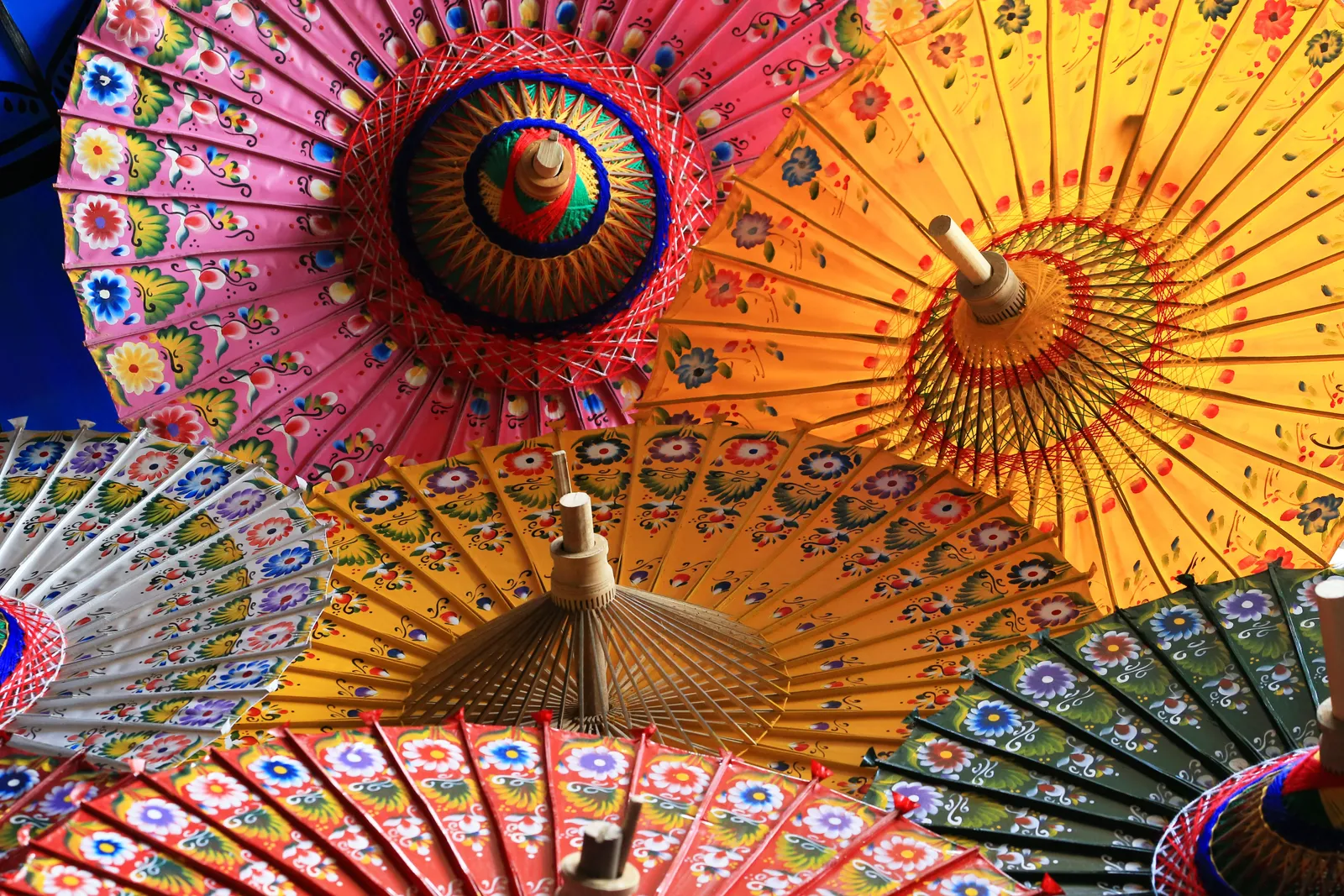
The best part of the class is not the eating but the pounding: a proper Thai curry paste is built in a mortar, garlic and chilli and galangal worked down by hand until the texture is right, and it is harder and more satisfying than it looks from the outside. In the afternoon, if you still have energy, the villages of Bo Sang and Wua Lai just outside the old city are known respectively for hand-painted umbrellas and silverwork, both still made by hand in workshops you can watch from the street.
Food: your own curry paste, pounded from raw ingredients and cooked into the dish you chose at the market.
The signature experience: the market walk-through and the hand-pounding, which turns a cooking class into something closer to a craft lesson.
Optional tour: an afternoon in Bo Sang and Wua Lai, the umbrella and silver villages, watching artisans work at the pace they always have.
Day 5: Chiang Rai day trip
Chiang Rai makes for a long but rewarding day out, home to three modern, artist-built sites unlike anything else in the country. Our Chiang Rai White Temple guide covers all three in more depth. The White Temple, still an active work in progress, is a blinding white and mirrored complex where a bridge lined with reaching hands leads visitors past temptation toward the main hall, a deliberate piece of religious art rather than an ancient monument. Nearby, the Blue Temple’s cobalt interior and gold Buddha make a striking contrast, and the Black House, part museum and part artist’s home, fills a cluster of dark timber buildings with animal bones, skins and strange sculptural furniture.
It is a full day on the road there and back, so build in a lunch stop along the way rather than trying to see everything and be back for dinner. If you are already stretched for time, the White Temple alone justifies the trip.
Food: a roadside lunch stop on the way north or south, a good chance to try northern food again away from the city.
The signature experience: crossing the bridge of hands at the White Temple, its mirrored spires catching the light from every angle.
Optional tour: for travellers with extra time and stamina, some day trips extend north toward the Golden Triangle, though it makes for a very full day.
Before you go
The north has its own rhythm and its own risks, worth knowing before you book. The burning season, roughly the early months of the year, brings smoke haze that can affect air quality for stretches at a time; check conditions if you are sensitive to it and consider timing your trip around it if you have flexibility. Pack layers for the mountain mornings, which are noticeably cooler than Bangkok or the islands, and book the elephant sanctuary and cooking class ahead, since the better operators run small groups and fill up. If you are reaching the north overland rather than flying, it is also worth stretching the trip by a day for Sukhothai, which sits well north of Bangkok and short of Chiang Mai and takes a deliberate detour to reach; that is precisely why its ruins stay quiet while Ayutthaya fills with coaches. Five days here moves at a different pace to the beach or the capital, and that slower pace is exactly the point. If you are still weighing this region against a fortnight on the sand, north or islands sets the two side by side, including the way their seasons invert so that the best months for one are the worst for the other.