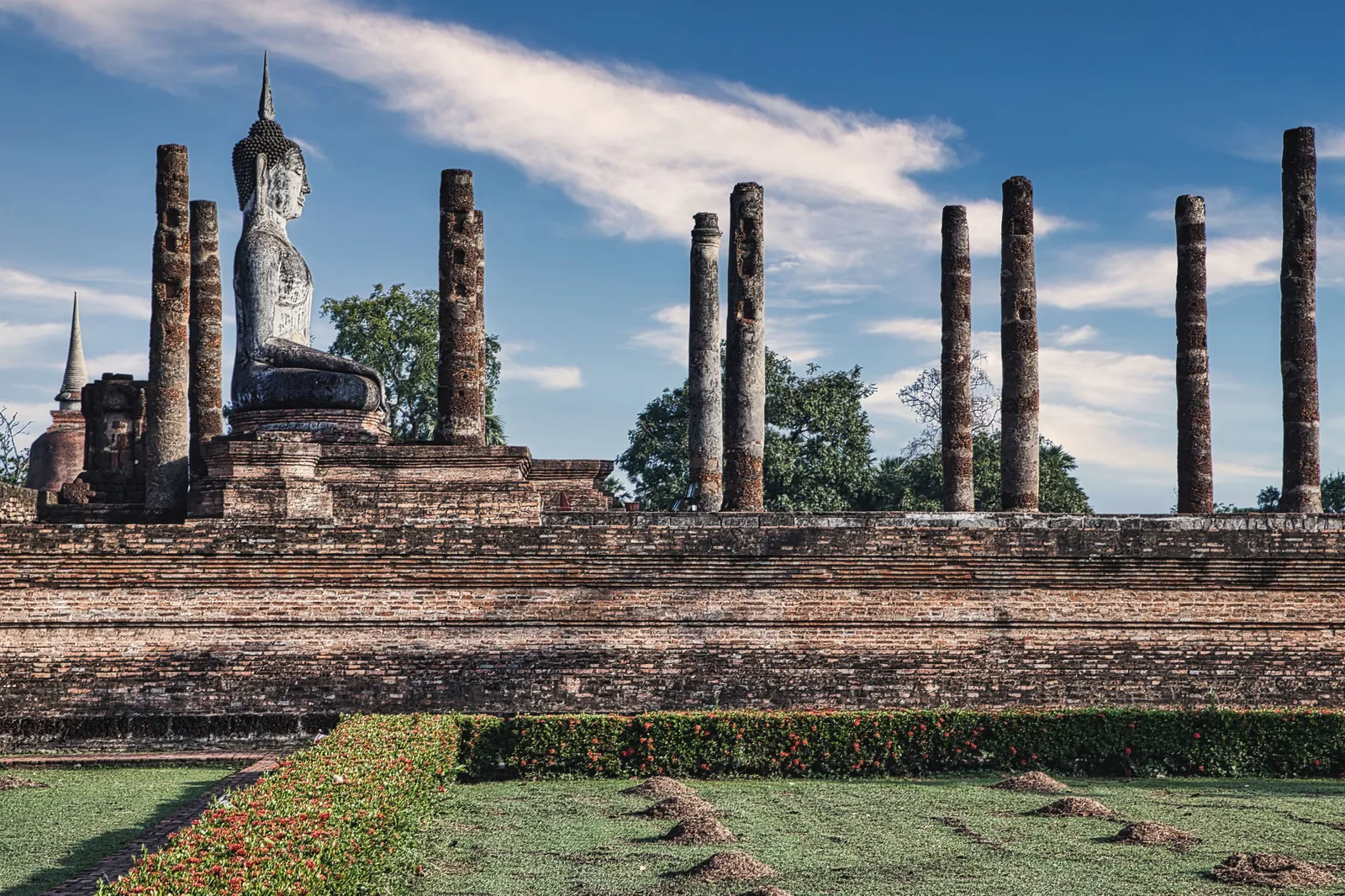
Sukhothai does not sit on the way to anywhere. It takes a deliberate detour to reach, well north of Bangkok and short of Chiang Mai, and that distance is exactly why the historical park at its centre still feels uncrowded next to the coach parties at Ayutthaya. This was Thailand’s first independent capital, founded in the thirteenth century after the region broke free of Khmer control, and the temples here mark the start of an artistic style that is recognisably, distinctly Thai. Ruined brick chedis rise out of still lotus ponds, tall seated and walking Buddha images watch over empty courtyards, and a bicycle carries you between them at a pace the place seems built for.
What Sukhothai actually was
A founding kingdom. Sukhothai broke away from Khmer authority in the mid-1200s and became, by most accounts, the first Thai kingdom in the sense the word is understood today. It lasted around two centuries before power shifted south to Ayutthaya, but its influence on language, religion and art long outlasted its political life.
The Thai script. Tradition credits one of Sukhothai’s kings with devising the Thai alphabet during this period, adapting earlier scripts into a form that is the direct ancestor of what is written across the country now.
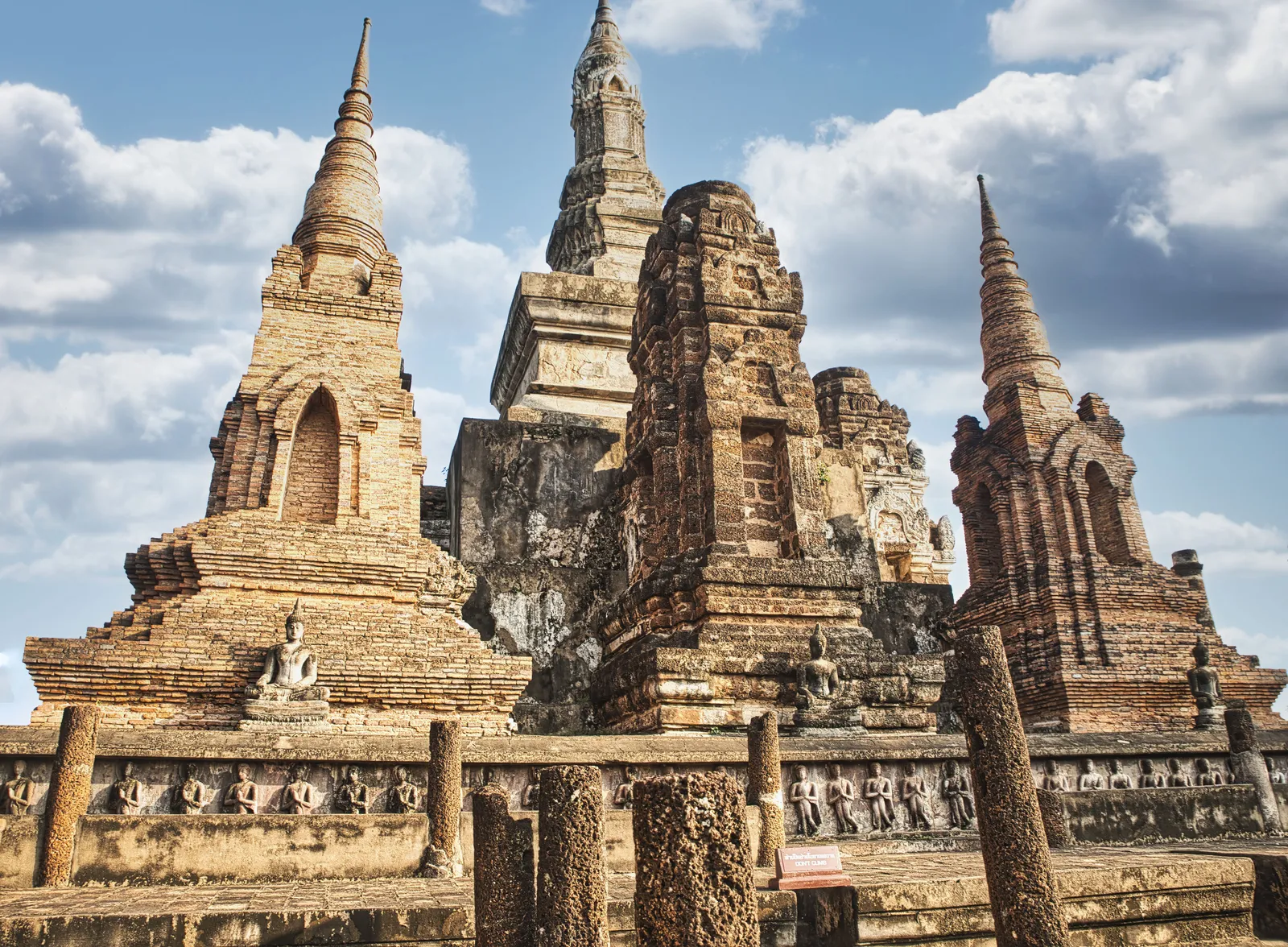
A new Buddha style. The walking Buddha, shown mid-stride with a raised hand, is generally considered a Sukhothai invention, and it appears nowhere in Khmer art that came before it. The seated images here, with their long faces and flame-like finials, are equally distinctive and were widely copied by later kingdoms.
A planned city. Unlike organic old towns that grew over centuries, Sukhothai’s core was laid out with intention: a rectangular moated centre with the royal temple at its heart, and satellite temple sites within and beyond the walls.
The historical park
The layout. The park is divided into a central zone inside the old moat, plus north, south and west zones a short ride beyond it. Most visitors focus on the central zone, which holds the largest and most photographed temples, but the outer zones are where the crowds genuinely disappear.
Wat Mahathat. The royal temple at the centre of everything, with a large seated Buddha, rows of standing Buddha images on a raised platform, and the kind of long reflecting views across water that make Sukhothai’s photographs distinctive.
Wat Si Chum. Just outside the central zone, home to one of the largest seated Buddha images in Thailand, housed inside a tall, narrow structure that frames the statue’s face through a gap in the brick, one of the more striking single sights in the park.
Wat Sa Si. A small, elegant temple on an island in a lake within the central zone, reached by a short causeway, and one of the more peaceful spots to simply sit for a while.
The scale. This is not a compact complex you walk in an afternoon. Distances between sites run into kilometres, which is why the park is built around cycling rather than walking.
Sukhothai versus Ayutthaya
Both are former capitals with UNESCO-listed ruins, and both turn up on the same shortlist when people ask which historical park to visit. They are worth comparing honestly rather than assuming one simply replaces the other.
Distance from Bangkok. Ayutthaya is a short train or bus ride, easily done as a day trip. Sukhothai is a genuine journey, whether by air or by a long bus ride, and it is not realistically a day trip from the capital.
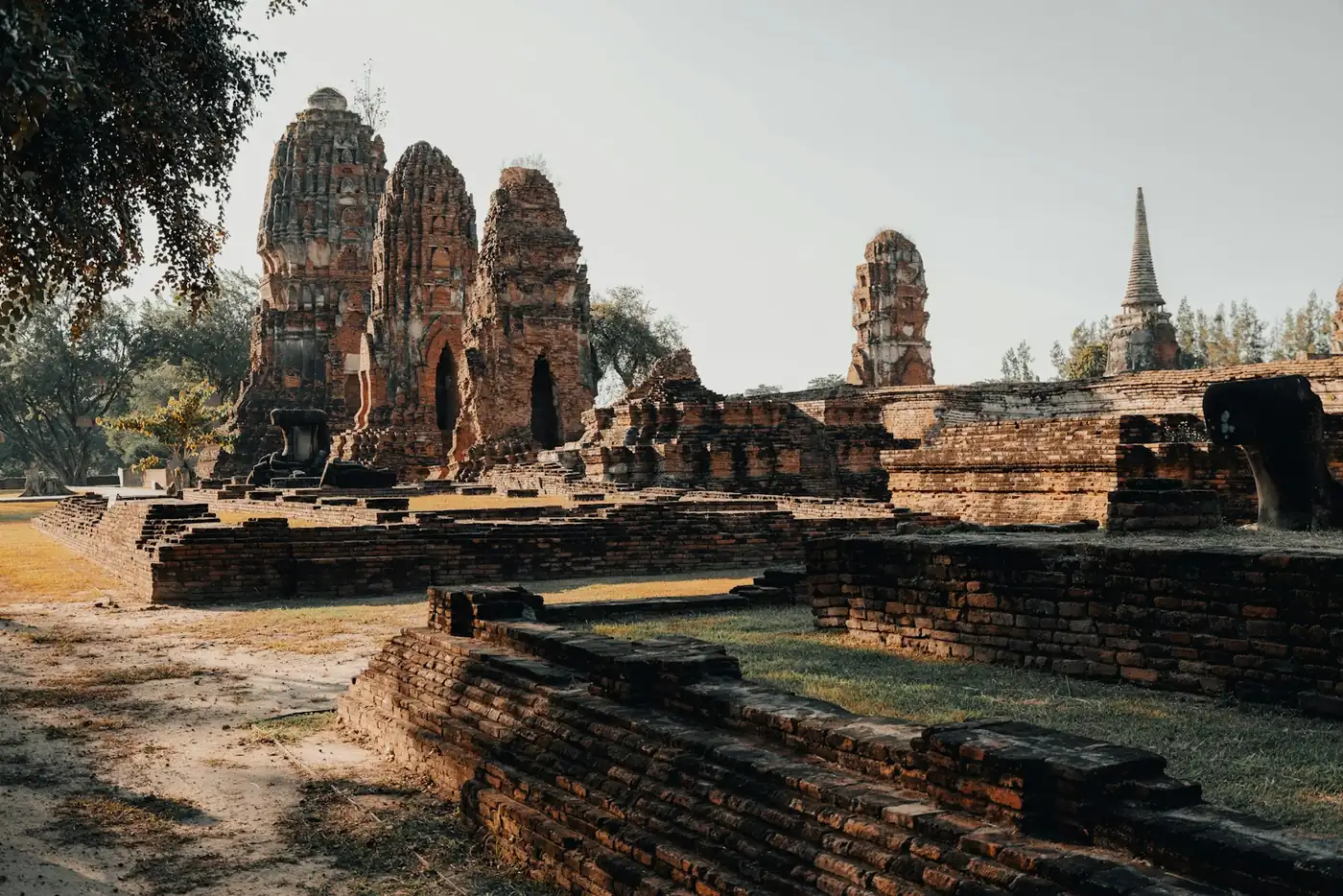
Setting. Ayutthaya’s ruins sit inside a modern working town, with roads, shops and traffic woven between temples. Sukhothai’s central zone is a dedicated park with grass, trees and water between the monuments, and nothing modern intrudes on the sightlines.
Crowds. Ayutthaya sees far more visitors, partly because of its convenience, and it shows in the numbers around the most famous sites. Sukhothai, largely because of the effort required to reach it, stays notably quieter even in busy periods.
Which to choose. If time is short and Bangkok is your base, the Grand Palace and Bangkok’s temples are the more realistic starting point. If you are travelling on to Chiang Mai or the north and can build in a stop, Sukhothai rewards the detour with a calmer, greener version of the same era of history.
Getting there and around
By air. Sukhothai has a small airport with a limited schedule of flights, and it is by far the fastest way in, though seats and routes are worth checking well ahead as capacity is modest.
By bus. Long-distance buses run from Bangkok and take most of a day. It is the cheapest route and a reasonable option if you are not in a hurry.
Via Phitsanulok. A larger town around an hour from Sukhothai, with better rail and bus connections, is a common stepping stone for travellers combining the historical park with onward routes north.
Inside the park. Rent a bicycle near the entrance rather than trying to walk it. Songthaews and tuk-tuks also cover the short hop between the modern town, where most accommodation sits, and the old city where the ruins are.
Beyond the main park
Si Satchanalai. A sister historical park roughly an hour north, smaller than Sukhothai itself and considerably quieter, with its own moated layout and temple ruins scattered through woodland. Worth a full extra day if the pace of Sukhothai already appealed to you and you want more of it.
The old town versus new town. Most hotels and restaurants sit in the modern town a short distance from the park, which is unremarkable but comfortable. The historical park itself has no accommodation inside it, so plan your base accordingly.
If ruins are not the only thing on your list
Sukhothai works well as one half of a trip that mixes history with nature rather than stacking temples on temples. If your route also has room for wildlife and forest rather than only brick and stone, a national park like Khao Yai, built around elephants, gibbons and a working vineyard rather than ruins, is worth planning in alongside it.
The short version
Sukhothai takes real effort to reach and repays it with a version of Thailand’s temple ruins that Ayutthaya, for all its convenience, cannot offer: space, quiet, water, and long uninterrupted views between monuments from a country’s founding era. Rent a bicycle, start early before the heat sets in, and give the central zone a full day if you can. This is also a natural stop on a longer loop north; our guide to Chiang Mai covers the city most travellers head to next, and our first-time guide to Thailand is worth reading before you plan how the historical parks fit into a wider itinerary.